THERMAL ENERGY
Meaning of Thermal Energy
Thermal energy is the energy possessed by a substance due to the motion of its particles. The faster the particles move, the higher the thermal energy of the substance. Thermal energy is also called heat energy.
Illustration of Thermal Energy with Activities
We can see and feel thermal energy in many simple ways. Here are some activities that help us understand how heat works:
-
Melting Ice: Take some ice cubes and put them in a beaker or bowl. Watch as the ice slowly melts into water.
This happens because heat energy from the air and surroundings moves into the ice. As the ice gains heat, the tiny particles in it start moving faster and the ice changes from solid to liquid.
-
Boiling Water: Pour water into a pot and heat it on a stove. You will see bubbles forming and rising to the surface.
The water gains thermal energy from the stove, which makes the water particles move faster. Eventually, the water changes into steam (gas). This shows how heat can make liquids change state.
-
Rubbing Hands: Rub your hands together quickly for a few seconds. You will feel your hands becoming warm.
The movement of your hands creates friction, and this friction produces thermal energy. This is a simple way to make heat without using fire or a stove.
-
Heating a Spoon: Place a metal spoon in hot water. After some time, touch the handle carefully and you will feel it getting warm.
Heat travels through the metal from the hot water to the handle. This shows that heat can move through solid objects.
-
Sunlight on Skin: Stand under the sun for a few minutes and feel the warmth on your skin.
The sun sends heat energy through light, which warms your body. This demonstrates that heat can travel through empty space.
These activities help us to see how thermal energy moves and changes things in everyday life. Heat can come from the air, water, friction, or even the sun.
Heat Flow
Heat is a type of energy that always moves from a hotter object to a colder object. This movement happens naturally and continues until both objects reach the same temperature. When heat flows, it makes the colder object warmer and can also make the hotter object a little cooler.
Example: If you put a metal spoon into hot tea, after some time the spoon becomes warm. This is because heat from the hot tea moves into the cooler spoon. The spoon will continue to get warmer until its temperature is closer to the temperature of the tea.
Another example can be seen when you touch a cold bottle of water while your hand is warm. Your hand feels cold because heat is moving from your warm hand into the colder bottle. Over time, your hand becomes slightly cooler, and the bottle becomes slightly warmer.
Heat flow can also be observed in daily life. For instance, if you leave a cup of hot chocolate on the table, it gradually becomes cooler because heat moves from the hot drink into the surrounding air. Similarly, ice in a drink melts because heat from the warmer liquid and air moves into the colder ice, causing it to change into water.
Heat flow happens in solids, liquids, and gases. Metals are good at transferring heat, so they feel hot quickly when placed in a warm environment. Materials like wood or plastic are slower to warm up because they do not transfer heat easily. Heat can even travel through empty space, such as the heat from the sun reaching the Earth.
Heat Transfer
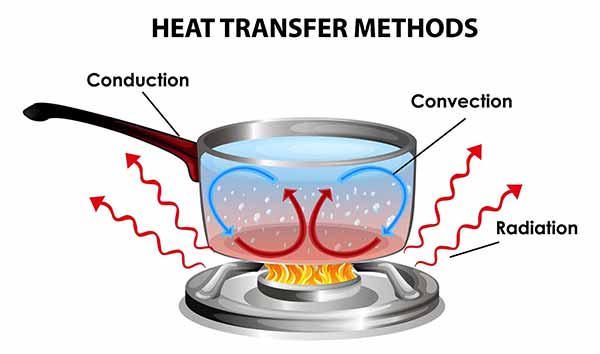
Heat transfer is the movement of thermal energy from one substance to another. There are three main ways:
A. Conduction
Definition: Transfer of heat through a substance without the movement of the substance itself, mainly in solids.
Example Activities:
- Place one end of a metal rod in a flame; feel the other end becoming hot.
- Place a metal spoon in hot water; the handle becomes warm.
Materials that conduct heat well (conductors): Metals like copper, iron, aluminum.
Materials that resist heat (insulators): Wood, plastic, rubber.
B. Convection
Definition: Transfer of heat through movement of liquids or gases due to density differences.
Example Activities:
- Boil water in a pot and observe hot water rising and cold water sinking.
- Heat air with a candle under a paper boat in water; the boat moves as hot air rises.
Key Point: Convection currents transfer heat efficiently in fluids (liquids and gases).
C. Radiation
Definition: Transfer of heat through electromagnetic waves without a medium.
Example Activities:
- Stand near a fire or stove and feel the warmth.
- Feel the heat from sunlight on your skin.
Key Point: Radiation does not need particles or a medium to transfer heat.
Sources of Thermal Energy
Thermal energy comes from many places. Some sources are natural, while others are made by humans. Here are the main sources of heat:
-
Sunlight: The Sun is the biggest source of heat. Sunlight travels through space and warms the Earth. It helps plants grow, keeps animals and humans warm, and can also warm water and homes.
-
Fire (wood, coal, gas): Burning wood, coal, or gas makes heat. We can use this heat for cooking, keeping warm, and lighting. People have used fire for thousands of years to cook food and stay warm.
-
Friction (rubbing hands, moving objects): When two things rub together, they make heat. For example, rubbing your hands together makes them warm. Machines with moving parts can also get hot because of friction.
-
Electric heaters or stoves: Devices like electric heaters, stoves, and kettles make heat when electricity flows through them. We use this heat for cooking, boiling water, and warming rooms.
-
Geothermal sources (hot springs, volcanoes): Heat from inside the Earth is called geothermal energy. Hot springs and volcanoes release this heat naturally. People can also use it to heat buildings or make electricity.
These examples show that thermal energy is everywhere. We can get heat from the Sun, fire, electricity, friction, and even from inside the Earth.
Effects of Thermal Energy
Thermal energy can cause many changes in objects and materials. Here are some common effects:
-
Expansion: Solids, liquids, and gases get bigger when heated.
Example: Railway tracks expand in hot weather, and water in a kettle rises as it heats.
-
Change of State: Heat can change a substance from one form to another.
Example: Ice melts to water, water boils to become steam, and steam can condense back to water.
-
Temperature Change: Heat can make things hotter or colder depending on the flow of energy.
Example: A cold drink warms up if left in the sun, and hot water cools down if left in a room.
-
Movement: Heat can make liquids and gases move, creating currents called convection currents.
Example: Warm water rises in a pot while cold water sinks, helping to mix the water.
-
Expansion of Air: Hot air expands and becomes lighter.
Example: Hot air balloons rise because the air inside becomes lighter when heated.
-
Effect on Machines: Heat can make parts of machines expand or move, which may affect how they work.
Example: Metal engine parts in a car expand when the engine gets hot.
-
Effect on Plants and Animals: Heat affects living things by changing their environment or body temperature.
Example: Plants may wilt in very hot weather, and humans feel hot and sweat to cool down.
Methods of Heat Insulation
Heat insulation is a way to stop or reduce the flow of heat from one place to another. Materials that do this are called insulators. Insulators are useful because they help us keep things hot or cold for longer, and they also protect us from getting burned.
Examples of Insulators:
-
Wood: Wood does not let heat pass through easily. That is why handles of cooking pots and pans are made of wood. You can hold the handle without getting burned even when the pot is hot.
-
Plastic: Plastic is another material that stops heat from moving. Thermos flasks are made of plastic to keep drinks hot or cold for a long time.
-
Glass wool and asbestos: These materials are used in buildings to stop heat from escaping in cold weather or entering in hot weather. They keep houses warm in winter and cool in summer.
-
Cloth and rubber: Clothes help keep our bodies warm because they prevent heat from escaping. Rubber gloves and mats also protect us from heat.
-
Air: Air trapped in small spaces acts as an insulator. For example, double-glass windows have air in between the glass to reduce heat loss or gain.
Using insulators is important in cooking, building houses, and protecting ourselves from hot objects. They help us to control heat and save energy.
Thermal Expansion
Definition: Thermal expansion is the increase in the size or volume of a substance when it is heated. This can happen in solids, liquids, and gases. When a substance gets hot, the tiny particles inside start moving faster. As the particles move more quickly, they push against each other and spread out. This spreading out makes the substance take up more space, which is called expansion.
How it happens: All substances are made of tiny particles called molecules. When heat is added, these particles move faster and farther apart. This makes solids, liquids, and gases get bigger. If the substance cools down, the particles move more slowly and come closer together, making the substance smaller again. This process of getting smaller is called contraction.
Applications of Thermal Expansion:
-
Bimetallic strips in thermostats: A bimetallic strip is made of two different metals joined together. When heated, one metal expands more than the other. This causes the strip to bend. The bending can be used to turn heaters or air conditioners on or off automatically.
-
Gaps in railway tracks: Railway tracks are built with small gaps between the rails. These gaps allow the metal to expand when the weather is hot. Without the gaps, the tracks could bend or break because of the heat.
-
Thermometers: In liquid thermometers, liquids like mercury or alcohol expand when they get hot. The liquid rises up the tube to show the temperature. When the liquid cools, it shrinks and moves back down.
-
Bridges: Bridges are made with expansion joints. These joints let the materials of the bridge expand in hot weather and contract in cold weather without causing cracks.
-
Metal lids on jars: Heating a metal lid makes it expand. This can make it easier to open the jar because the lid becomes slightly bigger and looser.
-
Electrical wires: Wires expand when they get hot due to electricity passing through them. Engineers leave small spaces or use flexible connections to prevent damage from this expansion.
Understanding thermal expansion is very important. It helps engineers, builders, and designers to prevent damage to bridges, railway tracks, machines, and many other things caused by heat. It also helps us understand why everyday objects like thermometers and jars behave the way they do when heated.
Measurement of Temperature
Temperature is a measure of how hot or cold an object or substance is. To know the temperature of something, we use a device called a thermometer. Thermometers are used in homes, schools, laboratories, hospitals, and weather stations to measure temperature accurately.
Thermometers usually show temperature in Celsius (°C) or Kelvin (K). Celsius is the most common scale used in everyday life, while Kelvin is often used in science and research. For example, water boils at 100°C and freezes at 0°C on the Celsius scale.
Types of Thermometers:
-
Mercury Thermometers: Mercury thermometers contain mercury, a silver-colored liquid metal, inside a glass tube. When the temperature rises, the mercury expands and moves up the tube. When the temperature falls, the mercury contracts and moves down. Mercury thermometers are very accurate, but they must be handled carefully because mercury is poisonous.
-
Alcohol Thermometers: Alcohol thermometers use colored alcohol instead of mercury. Alcohol expands and contracts like mercury when the temperature changes. These thermometers are safe to use and can measure very low temperatures, which makes them useful in cold regions.
-
Digital Thermometers: Digital thermometers use electronic sensors to measure temperature. They show the temperature on a digital screen. They are easy to use, fast, and safe because they do not contain harmful liquids. Digital thermometers are commonly used to check body temperature or room temperature.
Thermometers are very important in our daily life and in science. They help us to monitor weather, control heating and cooling systems, check the temperature of food, and measure body temperature to know if someone is sick. By using thermometers, we can understand and control temperature in many areas of life.
Transfer of Thermal Energy in Daily Life
- Cooking: Heat transferred from stove to food.
- Warm clothing: Retains body heat.
- Refrigeration: Removes heat to preserve food.
- Air conditioning: Removes heat from a room.
Safety Precautions When Using Thermal Energy
- Avoid direct contact with hot objects.
- Use protective handles or gloves.
- Ensure ventilation to prevent heat buildup.
- Handle hot liquids carefully to avoid burns.
Summary
Thermal energy is the energy that substances have because of the motion of their particles, and it increases as the particles move faster.
Heat can move from hotter objects to colder ones through conduction, convection, or radiation, causing effects like expansion, change of state, and movement of fluids.
Sources of thermal energy include the Sun, fire, friction, electricity, and the Earth’s heat, and we use it in daily life for cooking, heating, and many other activities.